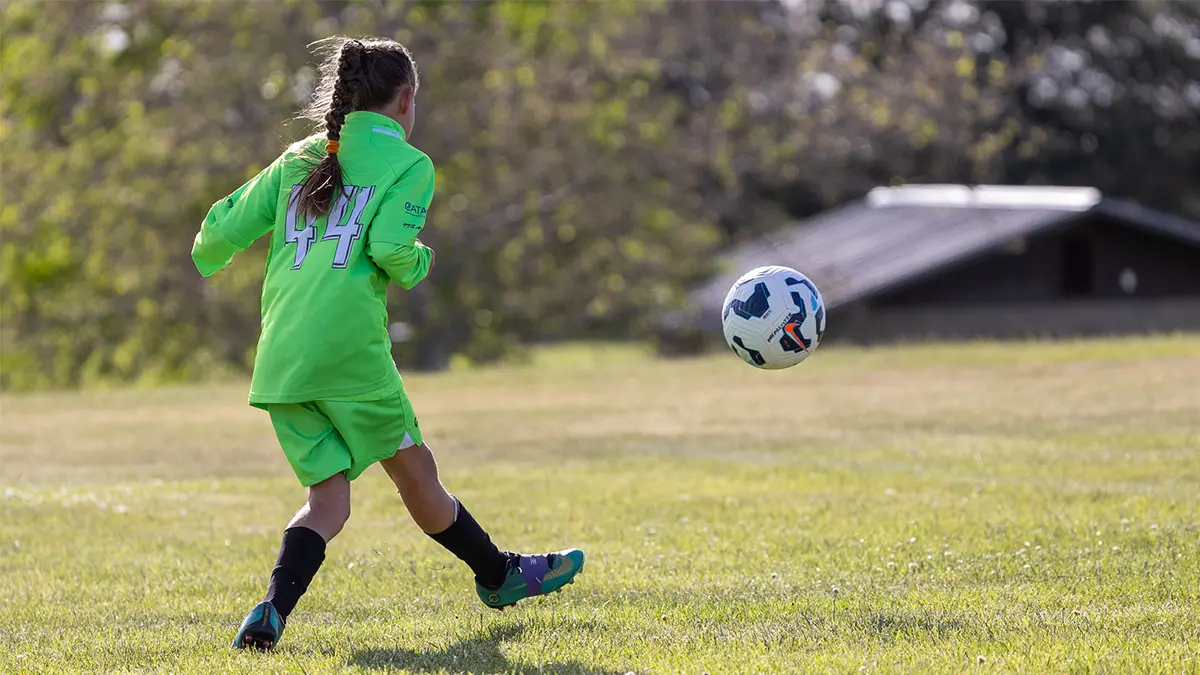
The game ends. Her team lost by one point. She played her heart out and it wasn’t enough, and now she’s sitting in the back seat, cleats still on, staring out the window. She doesn’t want to talk. She’s somewhere between tears and shutdown, and you’re in the front seat wondering what to do with the next ten minutes.
Those ten minutes matter more than you know.
Not because of what you say. Because of what you don’t say. Because of whether you rush toward a silver lining or whether you can sit in the weight of it long enough for her to feel that loss all the way through — and learn that she can survive it.
That capacity — to feel a hard thing completely and come out the other side intact — is not something children are born with. It is built. Slowly, deliberately, over years, through hundreds of small moments exactly like this one. And the research on what actually creates resilient, grounded, self-directed kids is unambiguous about where that building happens: in the relationship between a child and the adults who love them most.
“The best way for a young person to build character is to attempt something where there is a real and serious possibility of failure.” — Paul Tough, How Children Succeed
What we’re actually building — and what we’re accidentally preventing
Paul Tough spent years studying what actually predicts success in children — not test scores, not early enrichment programs, not cognitive ability. What predicted it was a cluster of noncognitive skills: persistence, self-control, curiosity, conscientiousness, and the ability to get back up. How Children Succeed makes the case plainly: these skills cannot be bought, manufactured, or installed by a parent who removes every obstacle. They are forged in contact with real difficulty.
Julie Lythcott-Haims watched this play out from the inside. As Stanford’s dean of freshmen for a decade, she saw wave after wave of high-achieving students arrive on campus technically accomplished and emotionally brittle — kids who had been so thoroughly managed, guided, rescued, and optimized that they had never developed the inner infrastructure to handle a hard thing on their own. Her book How to Raise an Adult names it without softening it: overparenting doesn’t protect children. It delivers them the message, over and over, that they cannot handle their own lives without adult intervention. And eventually, they believe it.
William Stixrud and Ned Johnson came at the same problem from a neuropsychology and coaching angle. In The Self-Driven Child, they found that the single greatest predictor of anxiety and depression in young people was a chronic lack of felt sense of control over their own lives. Not hardship. Not difficulty. The removal of it — by well-meaning parents who stepped in one too many times, smoothed one too many paths, solved one too many problems that belonged to their child.
The through-line across all of this research is the same: children need to fail. They need to lose. They need to be rejected, cut, passed over, and disappointed — and they need to do the work of recovering from it themselves, with a parent nearby who believes they can.
What failure actually looks like across childhood
The failures change shape as children grow. What matters is that parents are present for all of them — not to fix them, but to witness them and stay steady through them. The window for building this is longer than most parents realize, and it starts earlier than most expect.
Ages 4–7 — The game they can’t win yet
Losing at board games, not being picked first, not being the fastest. The foundation for tolerating disappointment is laid here — in tiny, low-stakes moments.
Ages 8–12 — The team, the audition, the tryout
Not making the team. The part going to someone else. The friend who chooses someone else. Social rejection and performance failure — both require the same core skill: I can survive this.
Ages 12–15 — The grade, the relationship, the exclusion
Academic failure, first romantic rejection, social hierarchies that feel like verdicts. Identity is forming. How failure is processed at this stage directly shapes self-concept.
Ages 15–18 — The high-stakes loss
College rejections, championship losses, relationships ending, major social ruptures. The failures are adult-sized now. The resilience infrastructure built in earlier years either holds or doesn’t.
Ages 18+ — The world, unmediated
No parent to call the coach. No adult to smooth the path. The young adult either has the inner tools to navigate setback — or discovers for the first time that they don’t.
Resilience is not a trait some children are born with and others aren’t. It is a skill set, built incrementally, through repeated contact with manageable difficulty inside a relationship that holds. The word ‘manageable’ matters — not because we should protect children from hard things, but because the difficulty needs to be sized to the developmental stage. A four-year-old losing at Candy Land is exactly the right size of hard. A four-year-old navigating adult-level conflict is not.
The brain underneath the loss
Daniel Siegel’s work on the developing brain gives us the framework that explains why parental response in these moments matters so much neurologically — not just emotionally.
When a child experiences failure or rejection, the emotional brain — the limbic system — fires hard. They are flooded. What Siegel calls the ‘downstairs brain’ is running the show: reactive, unregulated, unable to reason or plan. The ‘upstairs brain’ — the prefrontal cortex, where reasoning, perspective, and self-regulation live — goes partially offline. The child is not being dramatic. They are neurologically flooded, and they cannot think their way out of it from inside it.
What brings a flooded child back into their window of tolerance — that regulated space where they can think, feel, and integrate an experience — is not logic, silver linings, or problem-solving. It is co-regulation: the calm, present, non-anxious nervous system of a trusted adult, offered without agenda. Connection before correction. Presence before problem-solving.
This is why the ten minutes in the car after the loss matter so much. Not because of what you say. Because your nervous system, calm and steady, is telling your child’s nervous system: this is survivable. You are safe. I am not panicking, and neither should you be.
“Where attention goes, neural connection grows.” — Daniel Siegel
Over time, those repeated experiences of being flooded and then regulated — held by a calm adult until the nervous system can find its footing — actually build the neural pathways for self-regulation. The child eventually internalizes that experience. They develop their own capacity to tolerate distress, because they have been walked through it enough times that the brain knows the route.
The two failure responses that shape everything
There are two ways parents most commonly respond to a child’s failure — and both of them, in their extreme form, produce the same outcome: a child who hasn’t built the skills they need.
The Rescue Response
- “That coach doesn’t know what he’s doing.”
- “Let me call the school about that grade.”
- “You didn’t really lose — you played beautifully.”
- “I’ll handle it.”
The Witness Response
- “That was a hard loss. I watched you fight for every point.”
- “What do you think went wrong? What would you do differently?”
- “This hurts. It’s supposed to hurt. What do you need right now?”
- “I believe you can figure this out. I’m right here.”
The rescue response — however loving — delivers one message repeatedly: you cannot handle this without me. It protects the child from the discomfort of failure while simultaneously preventing them from building the experience of surviving it. Lythcott-Haims calls this soul-crushing precisely because it is: the child who is never allowed to struggle is never allowed to discover what they’re made of.
The opposite extreme — dismissing the loss, minimizing the pain, pushing the child to ‘toughen up’ and move on before they’ve processed — produces a different but equally damaging result. The child learns to disconnect from their own emotional experience. They stop bringing their pain to you. They develop a brittle competence that works until the loss is too big — and then it shatters because there’s no practiced skill underneath it.
The witness response sits between those two. It validates the experience fully, stays present through the flood, and then — when the child is regulated enough to receive it — gently turns the question back toward them. Not to solve. To believe in them.
How we build self-love alongside resilience
Resilience without self-worth is just endurance. A child can be taught to get back up over and over without ever being taught that they are worth getting up for — and those are not the same thing. The missing piece in most conversations about grit and perseverance is the relational foundation underneath it: a child has to know, at a bone-deep level, that their value is not determined by their performance.
This is built in the small, ordinary moments as much as the big ones. In whether you celebrate effort as loudly as outcome. In whether your love is visibly altered by a loss. In whether the first thing out of your mouth after a failure is a correction or a connection. In whether ‘I’m proud of you’ is something your child hears because of who they are, not just what they did.
A child who knows their worth is not on the line when they lose will take risks. They will try out for things they might not get. They will enter competitions they might not win. They will date people who might break their heart. They will apply for things that might say no. Because the no — however painful — is not a verdict on their value. It is information. And they have enough of a foundation under them to use it.
A child who has absorbed — through a thousand small moments of conditional love — that their worth tracks their performance will eventually stop trying. Not because they lack ambition, but because the stakes are too high. When every failure is existentially threatening, the safest move is to never put yourself in a position to fail.
“What matters most is not how much information we can stuff into a child in the first few years. What matters is whether we help her develop persistence, self-control, curiosity, conscientiousness, grit and self-confidence.” — Paul Tough, How Children Succeed
What this looks like in practice, across the years
- Start early and start small. Let the four-year-old lose the game without fixing the outcome. Let the seven-year-old be frustrated at a skill they haven’t mastered yet. Sit with them in it. Don’t rush to fix or reassure. The earlier children develop the experience of sitting inside discomfort with a regulated adult nearby, the wider their window of tolerance grows.
- Regulate yourself first. Stixrud and Johnson’s concept of the ‘nonanxious presence’ is one of the most important ideas in modern parenting literature. Your child’s nervous system is reading yours. If their failure makes you visibly anxious, ashamed, or desperate to solve — they feel it. Your calm is not indifference. It is the most regulating thing you can offer them.
- Connect before you correct. Siegel’s research is clear: a flooded brain cannot receive logic, coaching, or perspective. Feel the loss with them first. Sit in the car quietly. Let the first words out of your mouth acknowledge what just happened, not redirect it. Connection before correction is not permissive parenting — it’s neuroscience.
- Ask rather than tell. ‘What do you think happened?’ lands completely differently than ‘here’s what you should do differently.’ A child who is asked to analyze their own failure is building metacognition, self-awareness, and agency. A child who is given the analysis is building dependence on yours.
- Let the natural consequences land. The failed grade that requires summer school. The friendship that needed repair after they handled it badly. The scholarship they didn’t get because the essay wasn’t finished on time. These consequences are not cruel — they are instructive. They teach the relationship between effort, choice, and outcome in a way that no parental speech ever can.
- Name the emotions explicitly and often. Children who have language for their internal experience regulate better. Not ‘you’re fine’ — but ‘you’re disappointed. That makes complete sense. You worked hard for this and it didn’t go the way you hoped.’ Naming the emotion is not amplifying it. It’s giving the child the tools to hold it.
- Celebrate the attempt, not just the outcome. ‘I watched you get back up three times after you fell. That’s what I’m talking about’ is a different message than ‘you played great’ after a win. The former builds intrinsic motivation and grit. The latter builds performance orientation — and kids who are performance-oriented stop trying when the outcome is uncertain.
- Model your own failure out loud. Talk about the things you tried and didn’t get. The rejection you received. The project that failed. How you felt, how you processed it, what you learned. Children who watch adults navigate failure with honesty and without collapse are being taught the most important lesson — that failure is not the end of the story. It is part of it.
- In romantic rejection and social loss — don’t minimize it. The first heartbreak, the friend group that excluded them, the person who chose someone else — these are real losses and they feel enormous to a young nervous system. ‘There are other fish in the sea’ is well-intentioned and functionally useless. What actually helps is: ‘That hurt. Of course it did. You let yourself care about someone and it didn’t go the way you hoped. Tell me what it’s like.’
- Trust their capacity more than they do. The most powerful thing you can do after your child faces a loss is communicate — through your presence, your calm, and your words — that you believe they can handle this. Not ‘you’ll be fine’ as a dismissal. But ‘I know this is hard. I also know who you are, and I have watched you navigate hard things before. I’m not worried about you.’ That is not fixing it. It is believing in them. And children who are believed in, consistently, over time, tend to become people who believe in themselves.
The long game
The goal is not a child who never fails. The goal is a child who has a relationship with failure — who knows what it feels like, who has survived it before, who has a practiced set of skills for moving through it, and who has a deep enough sense of their own worth that a loss doesn’t rewrite their identity.
That child becomes an adult who takes risks. Who applies for things. Who enters relationships. Who tries new careers, new cities, new versions of themselves. Who is not paralyzed by the possibility of defeat because they have enough evidence, accumulated over years, that defeat is not final.
You build that child not in the victory celebrations, not in the college acceptances, not in the highlight reel moments. You build them in the back seat after the loss. In the kitchen after the rejection letter. In the hallway at 11pm when they come to you with a broken heart and you put down your phone and you stay.
The ten minutes after the hard thing. That is where it happens. That is where resilience lives.
You cannot build grit in a child you have never let struggle.
You cannot teach self-love to a child whose worth you have made conditional.
You cannot raise someone who knows how to lose
if you have spent their whole childhood making sure they never have to.
Capture the Journey — Not Just the Wins
We photograph young athletes at every stage — the hard work, the growth, and the moments that define a season. If you’re ready to document your athlete’s story, we’d love to be there.